



You placed the order, the supplier marked it shipped, and now you’re staring
at a string of letters and digits wondering what any of it means. Tracking an
Alibaba order is not complicated once you know where the number lives and how to
read the status updates. This walkthrough covers exactly that — no fluff, no
guesswork.
Find and read your tracking number
Where to find your tracking number on Alibaba

The number does not appear in just one fixed spot, and that alone trips up a
lot of first-time buyers. Check these three places in order:
- Order detail page. Open My Orders → the specific order →
View detail. Once the supplier hands the goods to a carrier, a tracking
field shows up under the shipment line. - Shipment notification. Alibaba sends a message to your
Message Center (and often your email)
the moment a tracking number is uploaded. Search “shipment” if you can’t spot it. - Trade Assurance / Logistics tab. Orders placed under Trade
Assurance have a dedicated logistics section that aggregates the number and the
carrier in one view.
If you still see “waiting to ship” with no number after the supplier claimed
dispatch, the number may simply not be uploaded yet — give it a day and recheck
before assuming something went wrong.
Alibaba’s built-in tracker vs third-party tools
Alibaba shows a basic tracking line on the order page, but it pulls from the
carrier feed and is not always the most detailed. Two practical alternatives:
- 17TRACK and ParcelsApp — free aggregators that
query hundreds of carriers at once. Paste your number and they often surface
scans Alibaba’s own view hides, especially on the destination-country leg.

- The carrier’s own site. For DHL, FedEx, UPS, SF Express, or
Cainiao, the carrier page is the primary source and usually the most current.
Use Alibaba’s view to confirm the order shipped, then drop the number into an
aggregator for the fuller picture. The number is the same — you’re just reading
it from a different window.
Reading the status and handling gaps
What each tracking status actually means
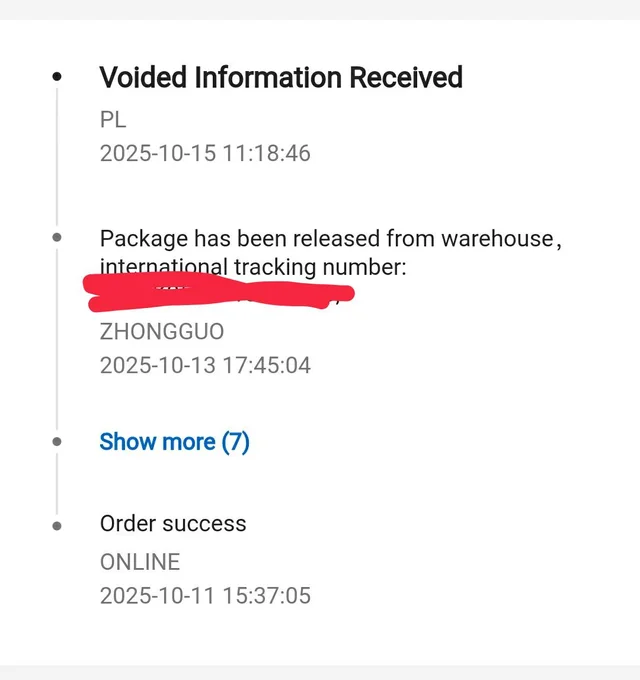
The words vary slightly by carrier, but the underlying states are consistent.
Here is the standard map:
| Status you’ll see | What it means | What you should do |
|---|---|---|
| Order placed / Awaiting dispatch | Payment captured; supplier hasn’t handed goods to a carrier yet. | Nothing. Wait for dispatch. |
| Shipped / Departed origin facility | Carrier has the parcel at the origin warehouse or airport. | Start tracking on the carrier or aggregator site. |
| In transit | Moving between facilities, or on a flight/vessel. | Normal. No action. |
| Arrived at destination country | Cleared the international leg and landed locally. | Expect local courier handoff soon. |
| Customs clearance | Held for import processing. | Have invoices ready; respond fast if the broker asks. |
| Out for delivery | On the local courier’s vehicle. | Be available to receive it. |
| Delivered | Marked received at the destination. | Confirm the parcel is actually yours. |
| Exception | A problem: address issue, failed delivery, or damaged label. | Contact the carrier or supplier immediately. |
The full Alibaba tracking number guide explains
why a number sometimes won’t return any result even when the status above looks
fine.

Why your tracking sometimes stops updating
A tracking line that freezes for several days is the single most common panic
trigger, and in most cases it is not a lost parcel. Usual causes:
- Carrier hasn’t scanned yet. Especially on ocean freight, there
can be a gap between “booked” and the first physical scan at the port. - Customs hold. The status may sit on “arrived” while a broker
works the paperwork. This is normal and resolves on its own. - Last-mile gap. The international carrier hands off to a local
one; the new carrier’s number may differ and the old one goes quiet. - Express vs ocean. Air express updates densely; sea freight is
scanned far less often by design.
If a number shows no movement for an unusually long stretch and the supplier is
unresponsive, that is when Trade Assurance tracking and buyer protection become your fallback.
Shipment legs, platform notes, and warning signs
Domestic leg vs international leg
One order can carry more than one number. The supplier may ship to a freight
forwarder’s warehouse first (domestic China leg), then the forwarder consolidates
and generates a second international number. If your first number “delivers” to a
city you don’t live in, you’ve likely just reached the warehouse — the
international number is the one that matters for the trip to your door.
Alibaba Logistics vs AliExpress — a quick clarification
Search results mix these up constantly, so to be clear:
Alibaba
here means the B2B marketplace (Alibaba.com) where businesses buy from suppliers
in bulk, and shipments are typically arranged through the supplier, a freight
forwarder, or a shipping agent.
AliExpress
is the B2C retail arm with its own prepaid postal-style shipping. Tracking
behaves differently on each — AliExpress orders usually arrive with a ready-made
tracking link, while Alibaba.com orders often require you to assemble the number
from the order page as described above. This guide covers the Alibaba.com side.
When to worry and what to do
A few quiet days is normal; a few weeks with zero scans plus an
unreachable supplier is not. Steps, in order:
- Re-paste the number into an aggregator and the carrier site to rule out a
display lag. - Message the supplier through Alibaba’s Message Center and request the latest
scan. - If the order is under Trade Assurance and the supplier stays silent past the
protected window, open a dispute from the order page to recover payment.
Before you ship, it helps to understand how the Alibaba platform works and what a freight forwarder actually does — both cut down on these surprises.
Common tracking mistakes that waste your time
- Relying only on Alibaba’s order page. It pulls from the carrier feed and lags behind. Open the carrier site or an aggregator for the live picture.
- Panicking at the first quiet stretch. A few days with no scan is normal on sea freight; only weeks of silence plus an unreachable supplier is a real problem.
- Confusing warehouse delivery with home delivery. If the first number “delivers” to a city you don’t live in, that’s the consolidation warehouse — the international number is the one that reaches your door.
- Not saving the number. A screenshot and a notes entry save you when the Message Center thread gets buried under newer orders.
- Ignoring the carrier handoff. When a number goes quiet, ask the supplier for the next carrier’s code rather than assuming the parcel is lost.

Frequently asked questions
How do I track an Alibaba order?
Open My Orders, find the order, and copy the tracking number from the shipment
line, then paste it into the carrier site or a tracker like 17TRACK.
What is an Alibaba logistics tracking number?
It is the carrier-assigned code (often S10-format for postal lines, or a private
express code for DHL/FedEx/UPS) that lets you follow the parcel across facilities.
Can I track Alibaba shipping without the supplier?
Yes — once you have the number, any aggregator or the carrier’s own site will
show scans independent of the supplier.
Why does my Alibaba delivery tracking show no update?
Usually a scan gap at customs, a carrier handoff, or simply a lightly-scanned
sea shipment. Weeks of silence with no supplier reply is the real warning sign.
What is an international tracking number on Alibaba?
The number that covers the cross-border leg — typically issued after the goods
leave China and handed to the line-haul or last-mile carrier.
Does Alibaba offer free shipping I should factor in?
Sometimes, but it is seller-driven, not platform-wide. See our breakdown of
whether Alibaba has free shipping and how to
actually get cheaper shipping.
How much will the freight cost me?
That depends on weight, volume, and method — our Alibaba shipping cost guide and freight calculator
walk through the math.