


How FBA inbound shipping from China actually works
Ordering from Alibaba and sending inventory to an Amazon fulfillment center are two different supply chains stitched together. Your supplier gets the goods to a Chinese origin point; from there the goods have to be prepped to Amazon’s specs, consolidated, cleared through export and import, and delivered to a specific FC with a booked appointment. The seller who treats this as one step usually misses the prep and booking windows.

The four legs of an FBA shipment
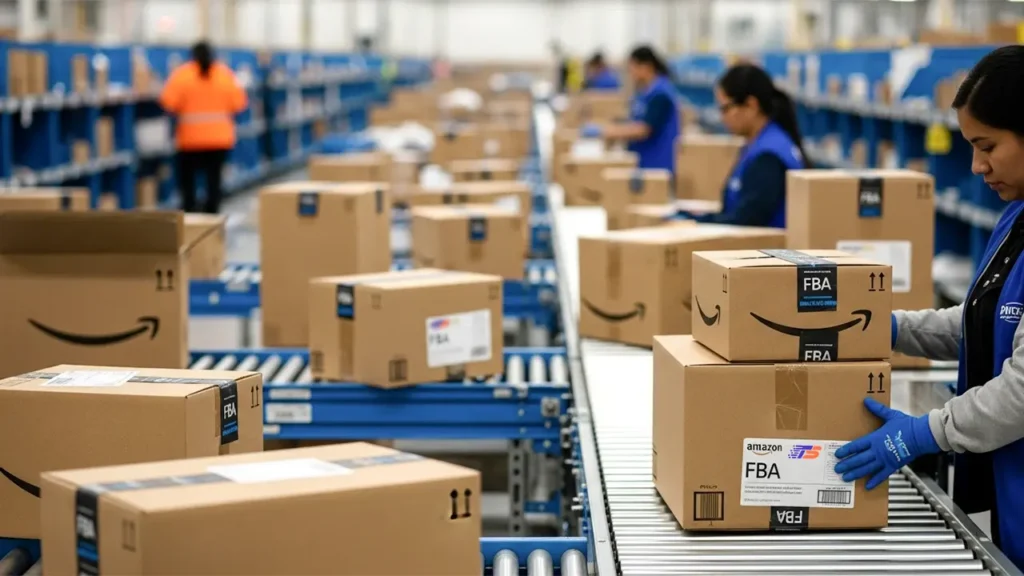
Leg one is factory to China warehouse: the supplier hands off EXW or delivers to your forwarder’s dock. Leg two is China-side prep: labeling, poly bagging, carton buildup, palletization. Leg three is international line haul by sea, air, or express with customs clearance at both ends. Leg four is delivery to the assigned FC with the Amazon Shipment ID and a booked slot.
Why most Alibaba orders still need a China-side forwarder
A courier can move a carton door to door, but it will not FNSKU your units, build compliant cartons, or file the import entry and deliver against an FBA appointment. A China shipping agent handles those handoffs so the carton that leaves the factory is the carton Amazon accepts.
Prep and labeling requirements you can’t skip
Amazon rejects inbound that does not match its labeling and packaging rules, and a reject means the whole carton is reworked or returned. The rules are boring but cheap to follow and expensive to ignore.
FNSKU labeling and barcode rules
Every sellable unit needs a scannable FNSKU, separate from the manufacturer barcode, applied where it is visible on the outside. Cartons need the Shipment ID label on every side. If your supplier’s labels are wrong, a pick and pack provider in China can relabel before export.
Poly bag, suffocation warning, and carton standards
Poly-bagged units over a threshold must carry a suffocation warning and be sealed. Cartons have weight and dimension limits and must be bundled correctly on the pallet. These are the details that decide whether a shipment is received on the first attempt.
Shipping methods to Amazon warehouses
Both sea and air reach an FBA center; the difference is cost per unit and how long you can wait.
Sea freight (FCL or LCL) to FBA
For a first or restock shipment measured in hundreds of kilograms or cubic meters, sea is the default. FCL fills a container; LCL shares one. Transit is weeks, not days, so it suits planned replenishment rather than emergencies.
Air freight and express courier to FBA
Air freight moves larger air shipments to a destination airport for clearance and final delivery; express couriers handle smaller, urgent parcels. Use these when a stockout costs more than the freight premium.
DDP versus paying duties yourself
Under DDP your forwarder clears customs and pays the import duty and VAT/GST, delivering the goods duty-paid to the FC. The alternative is paying the carrier’s or broker’s charges on arrival, which can surprise you with markup and delays. Our DDP shipping from China guide walks through when each model fits a small seller.
A simple cost model for a first FBA shipment
As an illustration, suppose a launch order is 400 kg and 1.8 CBM. A sea LCL quote might run a base plus a per-CBM and per-kg component, while air could be several times that for the same weight. Divide the total by your unit count to get landed freight per unit, then add product cost, prep, and duty. The mode you pick changes landed cost per unit by a margin that decides your price. Treat any single number as an example and get a live quote before booking.
Common mistakes that get shipments rejected at the dock
The same failures repeat across first-time sellers, and most are preventable at the warehouse stage.
Missing or wrong FNSKU
If Amazon cannot scan the unit, it cannot receive it. Confirm the FNSKU matches the SKU in Seller Central before the carton is sealed, not after it arrives.
Mixed SKUs in one carton
Amazon receives by SKU. Mixing two SKUs in one carton forces a manual split and often a rejection. Keep cartons single-SKU unless you have explicit mixed-SKU permission.
Closing
Shipping Alibaba goods to FBA is a China-side logistics problem first and an international shipping problem second. Lock the prep and booking steps before you commit to a mode, and the rest is arithmetic. A forwarder that handles Amazon FBA inbound can take the prep, clearance, and delivery off your plate.

FAQ
Do I need a freight forwarder to ship Alibaba goods to Amazon FBA?
In most cases yes. Alibaba suppliers ship EXW or FOB from a Chinese factory. A China-side forwarder picks up, consolidates, preps, and books the container or air waybill to the assigned Amazon fulfillment center. Couriers alone rarely handle FNSKU prep, palletization, and FBA appointment booking.
Can I send Alibaba goods to FBA using DDP?
Yes, and many sellers do. Under Delivered Duty Paid the forwarder clears customs and pays import duty and VAT/GST before delivery to the FC, so the shipment arrives clean. Read our guide on DDP shipping from China for the trade-offs versus paying duties yourself.
Who labels the cartons with FNSKUs?
Either your supplier or your China prep partner. The barcode must be scannable, applied to the outside of every sellable unit or the carton, and paired with the correct Shipment ID. A pick and pack provider in China can relabel mixed inventory before it leaves the warehouse.
Is sea or air better for a first FBA shipment?
For a launch with 200-500 kg and an 8-10 week runway, sea freight is usually far cheaper per unit. If you are restocking against a stockout, air or express wins on speed at several times the cost. The math depends on weight, volume, and how urgent the replenishment is.
What gets a shipment rejected at the Amazon dock?
Mislabeled or missing FNSKUs, multiple SKUs mixed in one carton, cartons over the weight limit, and missing pallet labels are the common rejects. Build the prep checklist before you book, not after the container is sealed.